
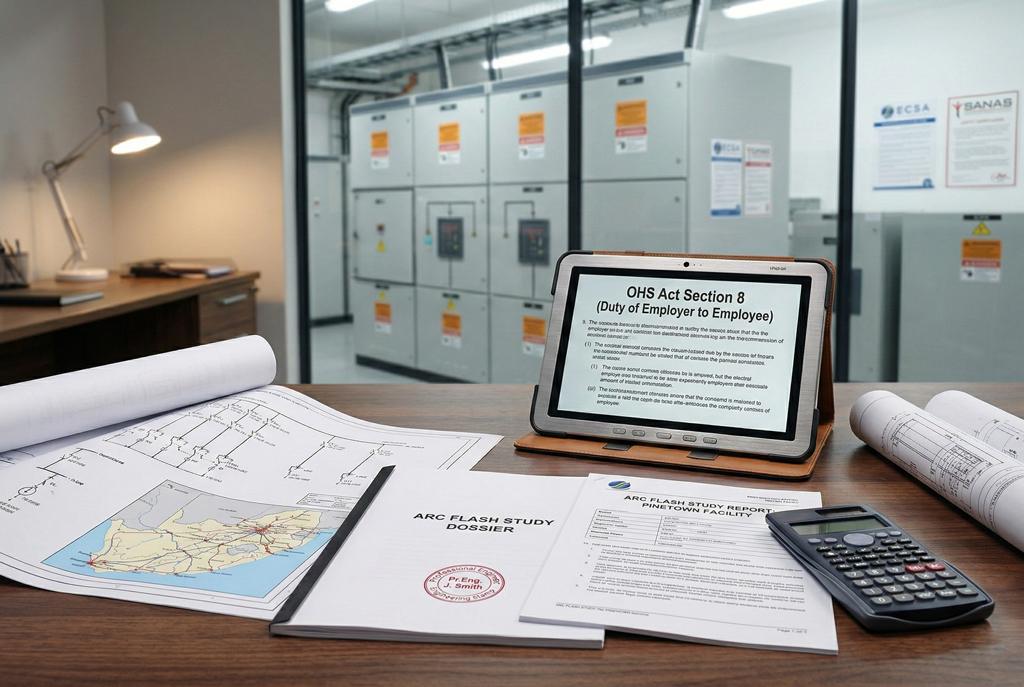
Electrical arc flash is a recognised workplace hazard in South Africa. Although it is not explicitly named in legislation, employers are legally required to identify electrical hazards, assess risks, and implement appropriate controls.
An arc flash study is one of the tools used to support this obligation. When specified and applied correctly, it provides technical evidence of hazard severity and informs decisions around labelling, procedures, PPE, and training.
This guide explains what an arc flash study is, when it is required in practice, how it supports South African compliance, and what facility owners and managers should realistically expect from the process.
What is an arc flash study?
An arc flash study is an engineering assessment of the thermal energy released during an electrical fault. It evaluates the potential severity of an arc flash event at specific items of electrical equipment and provides information to support safe work practices.
A typical study determines:
- Incident energy at equipment locations
- Arc flash boundary distances
- Arc Flash PPE requirements for electrical work
- Inputs for equipment labelling
- Engineering recommendations to reduce exposure
An arc flash study is not a legal certificate, a permit to work energised, or a substitute for operational controls. It is a technical input into broader electrical safety management.
Why arc flash matters in South Africa
Arc flash incidents can result in:
- Severe burns and long-term injury
- Damage to switchgear and distribution equipment
- Extended production downtime
- Regulatory intervention
- Insurance claims and investigations
South African law requires employers to take reasonably practicable steps to prevent such harm, regardless of whether a specific standard is named.
The legal framework
Occupational Health and Safety Act
The Occupational Health and Safety Act places a general duty on employers to:
- Provide and maintain a working environment that is safe
- Identify hazards
- Assess risks
- Implement appropriate controls
Electrical hazards, including arc flash, fall within this duty.
Electrical Installation Regulations
The Electrical Installation Regulations require:
- Safe design and operation of electrical installations
- Measures to protect persons working on or near electrical equipment
- Documentation demonstrating that risks have been considered
No regulation mandates a specific arc flash calculation standard. The obligation is outcome-based, not standard-based.
Use of international standards
Standards such as IEEE 1584 and NFPA 70E are not law in South Africa. They are widely used technical and safety frameworks that may be applied appropriately to support compliance.
In practice, these standards are often used because they:
- Provide a recognised engineering methodology
- Are accepted by insurers and multinational organisations
- Offer structured approaches to hazard analysis and control
Their value lies in supporting compliance, not replacing South African law.
Who typically requires arc flash studies
Arc flash studies are commonly commissioned by:
- Industrial and manufacturing facilities
- Commercial building owners
- Mining and processing operations
- Data centres and hospitals
- Multinational or US-owned facilities
- Facilities undergoing major electrical upgrades
In many cases, the trigger is a combination of legal duty, insurer requirements, corporate governance, or audit findings.
What inspectors expect to see
Inspectors from the Department of Employment and Labour do not audit against NFPA 70E or IEEE 1584. They typically expect evidence that:
- Electrical hazards have been identified
- Risk levels are understood
- Controls are in place
- Workers are trained and competent
- Management has taken reasonable steps to prevent harm
An arc flash study can support these expectations by providing documented technical evidence, but it must be integrated into procedures and training to be effective.
What a professional arc flash study includes
A properly specified arc flash study typically includes:
Electrical system verification
- Site walkthroughs
- Equipment identification
- Review of nameplates and ratings
- Verification of system configuration
Engineering analysis
- Electrical system modelling
- Short-circuit calculations
- Arc flash incident energy calculations
- Review of protection performance as it affects arc flash exposure
Documentation
- Technical report describing assumptions, results, and limitations
- Updated or annotated one-line diagrams
- Arc flash warning labels for relevant equipment
- Engineering recommendations for risk reduction
Professional accountability
- Review and sign-off by a registered Professional Engineer
- Documentation suitable for audits and insurers
What an arc flash study does not do
An arc flash study does not:
- Authorise energised work
- Eliminate electrical risk
- Replace lock-out procedures
- Replace training or supervision
- Guarantee regulatory or insurance outcomes
It provides information that management must act on.
Industry-specific considerations
Industrial and manufacturing facilities
- Multiple MCCs and distribution panels
- Frequent equipment modifications
- High reliance on uptime
Value: Improved planning of electrical maintenance and reduced unplanned outages.
Commercial buildings
- Tenant safety obligations
- Mixed-use electrical systems
- Aging infrastructure in older buildings
Value: Clear documentation supporting landlord and duty-holder responsibilities.
Mining and heavy industry
- High fault levels
- Surface and underground environments
- Increased regulatory scrutiny
Value: Valid risk assessments and reduced likelihood of work stoppages.
Multinational and US-owned facilities
- Corporate EHS requirements
- International insurer expectations
- Internal audit cycles
Value: Alignment between corporate standards and South African legal obligations.
The study process in practice
Data collection
- Review of existing drawings and documentation
- Site access for verification
- Utility fault current data collection
Engineering analysis
- System modelling
- Calculation and review
- Identification of high-risk locations
Reporting and handover
- Delivery of report and labels
- Discussion of findings
- Planning for implementation
Typical timeframes range from 4 to 8 weeks, depending on facility size and data quality.
When studies should be updated
Arc flash studies should be reviewed when:
- New transformers or major equipment are installed
- Protection settings change
- Utility fault levels change materially
- Operating configurations change
- The study reaches the end of its review cycle
A five-year review interval is commonly used as a general benchmark, but system changes are a more important trigger than time alone.
Choosing a suitable provider
Key factors to consider:
- Registration as a Professional Engineer in South Africa
- Experience with arc flash studies
- Use of current calculation methodologies
- Site-specific approach
- Clear scope and assumptions
- Ability to explain results to non-specialists
Unrealistically low pricing often indicates reduced field verification or generic assumptions.
Common misconceptions
“We have never had an arc flash incident”
Past experience does not remove legal duty or future risk.
“This is only for large facilities”
Arc flash risk depends on system characteristics, not company size.
“Labels alone are enough”
Labels are only effective when supported by procedures, arc flash PPE, and training.
What good implementation looks like
Effective arc flash risk management typically includes:
- Accurate labels on relevant equipment
- PPE matched to calculated hazards
- Clear procedures for electrical work
- Training aligned with site-specific risks
- Management oversight and review
The study provides the technical basis. Implementation delivers the safety outcome.
What this guide does and does not do
It does:
- Explain the purpose and limits of arc flash studies
- Clarify how studies support South African compliance
- Set realistic expectations for facilities
- Support informed decision-making
It does not:
- Provide legal advice
- Replace site-specific engineering assessment
- Guarantee outcomes
- Eliminate management responsibility
Final perspective
Arc flash studies are not about importing foreign standards or ticking compliance boxes. They are about applying sound engineering judgment to understand and manage a serious electrical hazard.
For South African facilities, the objective is clarity: understanding where risk exists, how severe it is, and what controls are reasonably practicable.
When treated as part of a broader electrical safety system, an arc flash study becomes a practical tool rather than an administrative burden.
Disclaimer
This article provides general information only and does not constitute legal advice, engineering design, or site-specific compliance guidance. Requirements vary by facility, industry, and operating context. Facilities should engage suitably qualified professionals for project-specific assessments.