
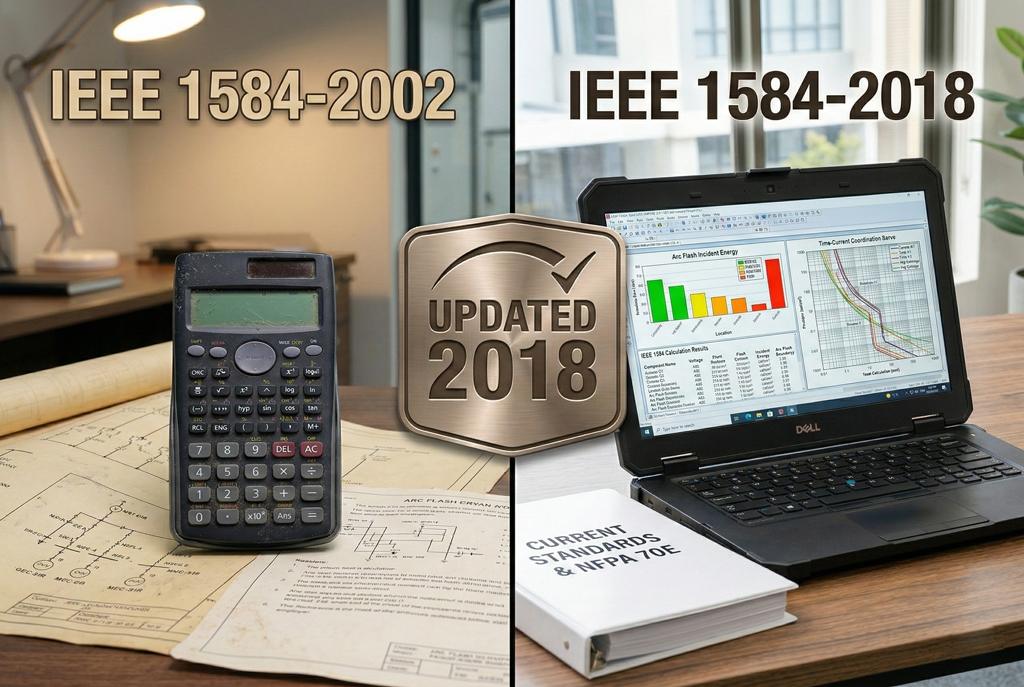
Many arc flash studies currently in use were completed using older calculation methods. While those studies may have been technically acceptable at the time, arc flash modelling has evolved significantly over the past two decades.
IEEE 1584-2018 is the current internationally recognised methodology for arc-flash incident-energy calculations. Understanding what changed, and what those changes mean in practice, is important for facilities that rely on arc flash studies to support electrical safety, insurance reviews, and corporate governance.
This article explains IEEE 1584-2018 in practical terms, clarifies when older studies should be reviewed, and places the methodology in the context of South African electrical safety obligations.
What is IEEE 1584
IEEE 1584 is a technical guide that defines how arc flash incident energy is calculated. It does not prescribe procedures, PPE programs, or legal compliance. Its purpose is to provide a consistent engineering method for estimating the thermal energy released during an arc-flash event.
Arc flash studies use IEEE 1584 calculations to determine:
- Incident energy at electrical equipment
- Arc flash boundary distances
- Inputs for PPE selection
- Data for equipment warning labels
IEEE 1584 is a calculation methodology, not a law or regulation.
IEEE 1584 and South African compliance
South African legislation does not mandate the use of IEEE 1584 or any other specific arc-flash calculation standard. The legal obligation is outcome-based: employers must identify electrical hazards, assess risks, and implement appropriate controls.
IEEE 1584-2018 is commonly used in South Africa because:
- It represents current industry engineering practice
- It is widely accepted by insurers and multinational organisations
- It provides defensible technical documentation
Using IEEE 1584-2018 supports compliance, but it does not replace South African legal requirements or management responsibility.
Why IEEE updated the standard
The original IEEE 1584-2002 equations were based on a limited test dataset. Over time, industry experience showed that those equations did not accurately reflect all equipment types, voltages, and configurations, particularly at common low-voltage levels.
IEEE undertook an extensive research programme involving thousands of laboratory tests across a wide range of conditions. The result was IEEE 1584-2018, which introduced a fundamentally revised calculation approach.
The update was driven by improved accuracy, not by regulatory change.
Key technical changes introduced in IEEE 1584-2018
Expanded and refined voltage modelling
IEEE 1584-2018 introduced separate calculation approaches for different voltage ranges, particularly improving accuracy for systems below 600 V, which are common in South African facilities.
This change reduced reliance on extrapolation and improved confidence in low-voltage results.
Detailed equipment configuration modelling
The 2018 methodology accounts for:
- Enclosure size and geometry
- Conductor orientation
- Electrode configuration
- Equipment type
Earlier methods relied on broader assumptions. The updated approach better reflects how arcs behave inside real equipment.
Revised arcing current calculations
IEEE 1584-2018 introduced more refined arcing current equations, which affect:
- Protective device operating times
- Calculated incident energy
- Coordination between devices
These changes can increase or decrease calculated values depending on system characteristics.
Inclusion of variation and uncertainty
The updated standard recognises that arc-flash behaviour is inherently variable. Calculations consider this uncertainty to support conservative PPE selection without relying on blanket assumptions.
What this means in practice
Facilities that update from older methodologies often see changes in the calculated incident energy. These changes are not universally higher or lower. Outcomes depend on:
- Equipment type
- Voltage level
- Protection characteristics
- Enclosure dimensions
- Working distances
The purpose of updating is accuracy and defensibility, not cost reduction or escalation.
Common misconceptions about IEEE 1584-2018
“Updating always reduces PPE requirements”
Not necessarily. Some locations may require higher PPE levels after recalculation, while others may require lower levels. Accuracy is the objective.
“Older studies are automatically unsafe”
An older study is not automatically invalid. However, it may no longer represent current engineering practice or current system conditions.
“This is a legal requirement”
IEEE 1584-2018 is not law in South Africa. Its use supports professional practice and risk management.
When an arc flash study should be reviewed
A review is typically appropriate when:
- The study predates IEEE 1584-2018
- The methodology used is not clearly stated
- Significant system changes have occurred
- Protection settings have changed
- Utility fault levels have changed materially
- The study has reached the end of its review cycle
Time alone is not the only trigger. System changes are often more important.
How insurers and auditors view methodology
Insurers and corporate auditors increasingly expect arc flash studies to:
- Use current, recognised calculation methods
- Be performed or reviewed by qualified professionals
- Be supported by site-specific data
- Be updated when material changes occur
Outdated methodologies may raise questions during audits or claim reviews, even if a study exists.
What IEEE 1584-2018 does not do
IEEE 1584-2018 does not:
- Define legal compliance
- Specify PPE programs
- Authorise energised work
- Replace procedures or training
- Guarantee safety outcomes
It provides calculation results that must be interpreted and applied through proper safety management.
Field verification remains essential
IEEE 1584-2018 requires more detailed input data than earlier methods. Accurate results depend on:
- Correct equipment identification
- Actual enclosure dimensions
- Verified protection settings
- Realistic working distances
Re-running calculations without field verification rarely produces reliable results.
Professional responsibility
Arc flash calculations influence life-safety decisions. For this reason, studies should be:
- Performed or reviewed by a registered Professional Engineer
- Based on verifiable data
- Clearly documented with assumptions and limitations
Professional accountability matters more than the software or formula used.
Planning an update
For facilities considering an update:
- Confirm the methodology used in the current study
- Identify system changes since the last assessment
- Determine whether a partial update or full reassessment is required
- Plan updates around maintenance or shutdown windows where possible
Most facilities complete updates within several weeks, depending on size and complexity.
What this article does and does not claim
It does:
- Explain why IEEE 1584-2018 replaced earlier methods
- Clarify how the methodology fits into South African practice
- Support informed decision-making about study updates
- Improve technical literacy for non-specialist decision-makers
It does not:
- Claim legal obligation to use IEEE 1584-2018
- Guarantee PPE reductions or cost savings
- Replace site-specific engineering assessment
- Provide legal advice
Final perspective
IEEE 1584-2018 reflects the current state of arc flash calculation science. Using it is not about chasing standards for their own sake. It is about ensuring that decisions affecting worker safety are based on the best available engineering knowledge.
For South African facilities, the question is not whether IEEE 1584-2018 is mandatory. The question is whether your arc flash study reflects current practice, current system conditions, and defensible professional judgment.
When methodology, data, and implementation align, arc flash studies become a reliable part of electrical safety management rather than a compliance concern.
Disclaimer
This article provides general information only and does not constitute legal advice, engineering design, or site-specific compliance guidance. Requirements vary by facility, system configuration, and operating context. Facilities should engage suitably qualified professionals to review or update arc flash studies.