
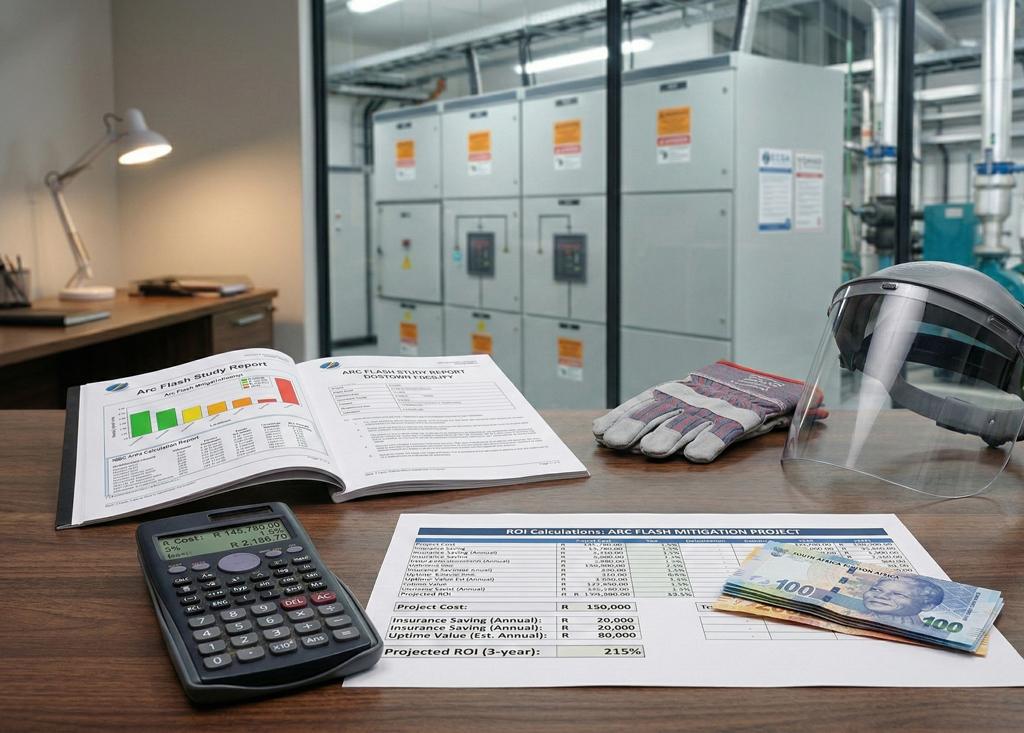
“How much does an arc flash study cost?” is a common question.
A more useful question is: what level of effort, time, and professional input is required to do it properly?
Arc flash studies are engineering assessments that support electrical safety, insurance defensibility, and regulatory compliance. Their cost and duration vary widely depending on the facility, the electrical system, and the quality of available information.
This article explains typical cost ranges, timelines, and influencing factors for arc flash studies in South Africa, without overstating savings or promising outcomes that depend on site-specific conditions.
What an arc flash study includes
An arc flash study is not a single calculation or a generic report. A properly scoped study typically includes:
- Field verification of electrical equipment
- Electrical system modelling
- Short-circuit and protection analysis
- Arc flash incident energy calculations
- Engineering interpretation of results
- Documentation and reporting suitable for audits and insurers
The study provides technical inputs. It does not, on its own, implement controls, provide training, or guarantee compliance outcomes.
Typical cost ranges in South Africa
Arc flash study pricing in South Africa varies primarily with system size and complexity. The ranges below reflect typical market observations, not fixed fees.
Small facilities
Examples include small commercial buildings, light industrial sites, or facilities with limited distribution.
- Typical scope: 1 – 3 Substations
- Indicative cost range: R65 000 – R 80 000.
- Typical duration: 3 – 4 weeks
Medium facilities
Examples include manufacturing plants, warehouses, and multi-tenant commercial sites.
- Typical scope 3 – 5 Substations
- Indicative cost range: R65,000 – R120,000
- Typical duration: 4 – 6 weeks
Large facilities
Examples include large industrial plants, hospitals, and complex production facilities.
- Typical scope: 5+
- Indicative cost range: R120,000 – R 400 000
- Typical duration: 6 – 10 weeks
Very large or campus facilities
Examples include mining operations, refineries, and multi-site campuses.
- Typical scope: 300+ equipment locations
- Indicative cost range: R250,000 and above
- Typical duration: 10 – 16 weeks
These ranges assume a professionally executed study performed by a suitably qualified engineer using recognised methodologies.
Why arc flash study costs vary
Number of equipment locations
Each panel, switchboard, MCC, or piece of switchgear requires individual analysis.
Costs do not increase strictly linearly, but larger systems require:
- More field verification
- More modelling effort
- More coordination analysis
- More documentation
Electrical system complexity
Radial systems with a single utility supply are generally simpler to analyse than systems with:
- Multiple transformers
- Generator or UPS sources
- Tie breakers
- Multiple operating configurations
More operating scenarios increase engineering effort and review time.
Voltage levels
Facilities with multiple voltage levels require:
- Transformer modelling
- Multiple fault calculations
- Additional validation of protective device behaviour
This increases both calculation and verification effort.
Quality of existing documentation
Accurate, up-to-date documentation reduces time and costs.
Common challenges include:
- Outdated or missing one-line diagrams
- Unknown protection settings
- Equipment nameplates that are inaccessible or unreadable
Where documentation is poor, additional site work and reconstruction are required.
Geographic location
Remote or difficult-to-access sites may incur additional travel and accommodation costs, particularly for multi-day field work.
New study versus update
Updating a recent, well-documented study is typically less costly than performing a study from scratch. Updates may range from 40–60% of the cost of a new study, depending on the extent of system changes.
What is typically included in the fee
A professional arc flash study commonly includes:
Field work
- Site walkthroughs and verification
- Equipment data collection
- Review of protection devices and settings
- Verification of system topology
Engineering analysis
- Electrical system modelling using professional software
- Short-circuit calculations
- Arc flash incident energy calculations
- Review of protection coordination as it affects arc flash exposure
Deliverables
- A technical report suitable for audits and insurers
- Updated or annotated one-line diagrams
- Arc flash warning labels for applicable equipment
- Engineering recommendations
Professional accountability
- Review and sign-off by a registered Professional Engineer
- Documentation suitable for regulatory and insurance scrutiny
What is usually not included in the fee
Costs typically do not include:
- PPE procurement
- Implementation of protection setting changes
- Equipment upgrades or retrofits
- Training delivery
- Legal advice
- Ongoing maintenance beyond the defined scope
These items should be clearly identified and priced separately.
Typical timeline breakdown
Phase 1: Initiation and data collection
- Project kickoff
- Review of existing documentation
- Site access coordination
- Field verification
Typical duration: 1–2 weeks
Phase 2: Engineering analysis
- System modelling
- Fault and arc flash calculations
- Engineering review
Typical duration: 2–4 weeks
Phase 3: Reporting
- Drafting and internal review
- Professional sign-off
- Label preparation
Typical duration: 1–2 weeks
Phase 4: Handover
- Report presentation
- Clarification of findings
- Planning for implementation
Typical duration: 1 week
Actual timelines depend on site access, data availability, and review cycles.
Fast-track studies
Expedited studies may be possible where:
- Documentation is complete
- Site access is unrestricted
- Scope is clearly defined
Fast-track work usually attracts a premium and should be reserved for genuine compliance or insurance deadlines.
Cost versus value considerations
Arc flash studies are often evaluated purely on cost. A more useful assessment considers risk exposure and decision support.
A study may:
- Provide evidence of hazard identification and assessment
- Support insurance discussions
- Inform PPE and work practices
- Reduce uncertainty during audits and inspections
- Improve consistency in electrical safety management
Actual financial returns vary significantly by facility and insurer and should not be assumed without verification.
Common misconceptions
“Small facilities should be cheap”
Professional engineering effort, software, and liability do not scale down proportionally with system size.
“Any engineer can do this”
Arc flash studies require specialist knowledge, professional registration, and appropriate tools.
“A low quote is a good deal”
Unrealistically low pricing often reflects:
- Limited field verification
- Generic assumptions
- Outdated methodologies
- Minimal professional review
These risks usually surface later during audits or incidents.
Selecting a suitable provider
When comparing proposals, look for:
- Professional Engineer registration
- Explicit use of current calculation methodologies
- Clear scope and exclusions
- Site-specific approach
- Examples of similar work
- Transparent timelines and deliverables
Price alone should not be the deciding factor for a life-safety assessment.
Planning and budgeting guidance
Facilities typically budget for arc flash studies:
- As part of safety or compliance programmes
- During planned shutdown or maintenance windows
- When insurers or auditors request updated assessments
- After major system modifications
Early planning reduces disruption and avoids rushed decisions.
What this approach does and does not do
It does:
- Provide realistic expectations for cost and timeline
- Support informed budgeting decisions
- Clarify scope and effort involved
- Reduce uncertainty during procurement
It does not:
- Guarantee insurance premium reductions
- Eliminate electrical risk
- Replace implementation responsibilities
- Substitute for legal or operational controls
Final perspective
Arc flash studies are a professional engineering service, not a commodity. Their cost reflects the level of responsibility, technical judgment, and accountability required.
The objective is not to minimise upfront spend, but to obtain a defensible, technically sound assessment that supports safe electrical work and withstands regulatory and insurance scrutiny.
When specified correctly and executed professionally, the study becomes a foundation for effective electrical safety management rather than a recurring compliance burden.
Disclaimer
Cost ranges and timelines presented here are indicative only. Actual costs depend on facility-specific conditions, scope, location, and insurer or corporate requirements. This article does not constitute legal or engineering advice. Facilities should obtain site-specific proposals from suitably qualified professionals.