
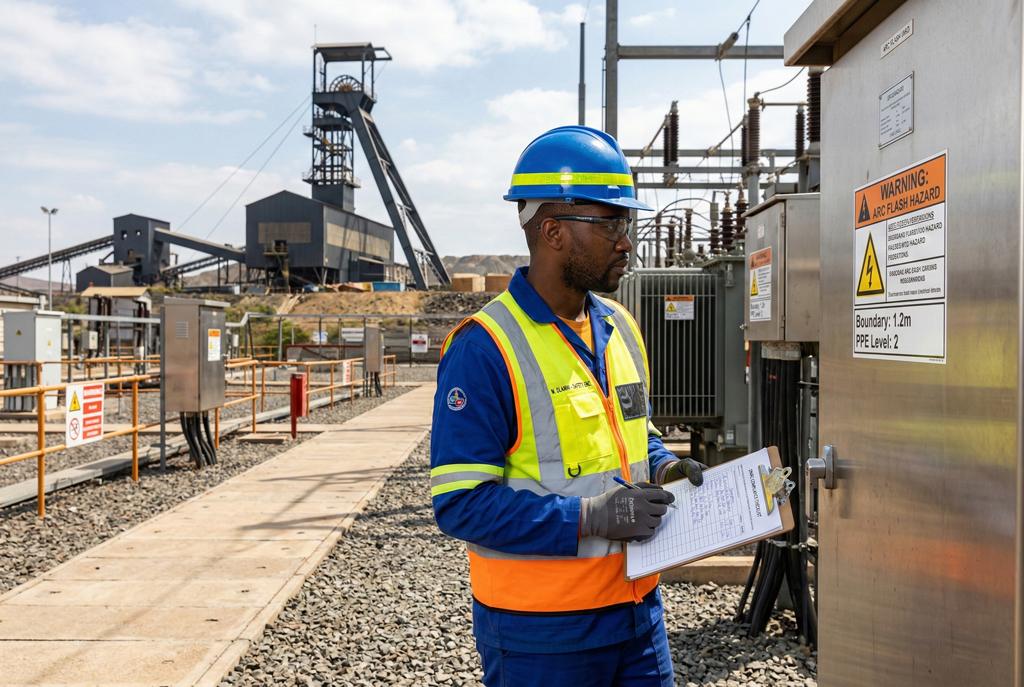
Electrical safety in mining is inseparable from production continuity, regulatory compliance, and license security. Unlike most industries, a single electrical incident underground or at a main surface substation can halt operations entirely, trigger regulatory intervention, and expose management to personal liability.
Arc flash studies play a critical role in managing this risk. When properly executed, they support compliance with South African mining legislation, improve worker protection, and reduce the likelihood of unplanned production losses caused by electrical incidents.
This article explains how arc flash studies are used in South African mining operations, what regulators and insurers typically expect, and how mines can implement them in a practical, defensible way.
What an arc flash study does in a mining context
An arc flash study is an engineering assessment that evaluates the thermal energy released during an electrical fault. In mining operations, it is used to:
- Quantify incident energy at electrical equipment
- Define arc flash boundaries
- Inform PPE selection for electrical work
- Support safe work procedures and training
- Identify locations where engineering controls are required
An arc flash study is not a legal exemption and not a substitute for operational controls. It is a technical input into broader electrical safety management.
Why mining operations face higher arc flash risk
Mining electrical systems differ significantly from typical industrial installations.
High fault levels
Mines are designed to reliably deliver large amounts of power. This results in:
- Large transformers, often operating in parallel
- Extensive motor loads such as winders, crushers, pumps, and ventilation fans
- High available fault currents at both medium and low voltage levels
Higher fault current generally translates to higher potential incident energy during an arc flash event.
Surface and underground environments
Mining electrical installations span two very different working conditions:
- Surface substations, plants, and workshops
- Underground substations, section switchgear, and shaft infrastructure
Underground installations often involve confined spaces, shorter working distances, and limited emergency access, which increases exposure risk even when incident energy values are similar.
Production-critical equipment
Electrical equipment in mining is often directly tied to:
- Shaft access and winding systems
- Ventilation and refrigeration
- Dewatering and pumping
- Ore handling and processing
An electrical incident can therefore trigger immediate production stoppages and regulatory intervention.
The regulatory framework for mining electrical safety
Mining operations in South Africa are subject to dual regulatory oversight.
Mine Health and Safety Act
The Mine Health and Safety Act requires employers to:
- Identify hazards
- Assess risks
- Implement reasonably practicable measures to protect workers
Although arc flash is not named explicitly, electrical hazards fall squarely within these duties. Standards referenced under mining regulations require documented risk assessment, safe systems of work, and competent persons.
Inspectors have the authority to issue stoppage notices where unsafe conditions are identified.
Occupational Health and Safety Act
In parallel, the Occupational Health and Safety Act applies to workplaces more broadly and imposes similar duties regarding electrical hazards, particularly where contractors or non-mining employees are involved.
Compliance with one Act does not exempt a mine from the other.
What regulators typically expect to see
Inspectors do not audit against NFPA 70E or IEEE 1584 directly. Instead, they look for evidence that:
- Electrical hazards have been identified
- Risk levels are understood
- Controls are implemented and documented
- Workers are trained and competent
- Management has taken reasonable steps to prevent harm
An arc flash study supports this by providing defensible technical evidence of hazard severity and informing the selection of controls.
Why insurers request arc flash studies in mining
Mining insurance exposure is high. Electrical incidents can result in:
- Severe injuries
- Extensive equipment damage
- Long production interruptions
- Complex claims investigations
Insurers, therefore, often request arc flash studies as part of underwriting or renewal, particularly for mines with high-power electrical systems.
IEEE 1584-2018 is commonly accepted because it reflects current industry research and provides a consistent calculation framework. Requirements vary by insurer and policy and should always be confirmed.
Using international standards appropriately
International standards such as NFPA 70E and IEEE 1584 are not law in South Africa. Their value lies in providing:
- A recognised engineering methodology
- A structured approach to hazard analysis
- Consistent terminology for multinational operations and insurers
In mining, these standards are typically used as supporting technical tools, integrated into South African legal compliance rather than treated as compliance in themselves.
Surface versus underground considerations
Surface installations
Surface substations and plants typically involve:
- Higher voltages
- Larger equipment
- More space for engineering controls
These areas often present the highest calculated incident energy levels, making engineering mitigation particularly important.
Underground installations
Underground electrical work introduces additional factors:
- Reduced working distances
- Limited escape routes
- Environmental stress on equipment
- More complex emergency response
Arc flash studies must reflect actual working conditions rather than generic assumptions.
When PPE is not enough
In mining, it is common to identify locations where calculated incident energy exceeds the practical limits of PPE.
In such cases, risk reduction relies on engineering and administrative measures, such as:
- Faster protective device operation
- Improved coordination
- Zone-selective interlocking
- Remote operation
- Changes to work practices to minimise energised work
Identifying these locations is one of the most valuable outcomes of a study.
Implementation is where most failures occur
Many mining operations commission studies but fail to fully implement the findings. Common gaps include:
- Labels not installed everywhere required
- PPE procured but not issued or maintained
- Procedures written but not applied
- Training conducted but not documented
- Studies not updated after system changes
From a regulatory and insurance perspective, these gaps matter as much as the study itself.
Keeping mining arc flash studies current
Arc flash studies must be reviewed when:
- New transformers or major equipment are added
- Protection settings change
- Operating configurations change
- Significant incidents occur
- The corporate or insurer update cycle is reached
Mining electrical systems evolve continuously, and studies must reflect the current state of the system.
Selecting the right engineering support
Mining arc flash studies require specialist expertise. Key considerations include:
- Registration as a South African Professional Engineer
- Experience with mining electrical systems
- Familiarity with underground installations
- Use of current calculation methodologies
- Ability to address both mining legislation and insurer expectations
- Competence in proposing practical mitigation measures
Generic industrial studies often fail to adequately address mining-specific risks.
What a well-structured study achieves
When properly specified and implemented, an arc flash study can:
- Strengthen compliance with mining safety legislation
- Improve worker protection during electrical work
- Reduce the likelihood of unplanned production stoppages
- Support insurer risk assessments
- Improve audit and inspection outcomes
It does not eliminate risk, but it significantly improves how that risk is understood and managed.
What this approach does and does not do
It does:
- Provide a justifiable technical basis for managing arc flash risk
- Support regulatory inspections and insurance reviews
- Highlight locations requiring additional controls
- Improve consistency in electrical safety practices
It does not:
- Replace legal advice
- Guarantee regulatory outcomes
- Remove management responsibility
- Eliminate the need for competent supervision and training
Final perspective
Mining operations operate under greater electrical risk, greater regulatory scrutiny, and greater operational consequences than most industries. Arc flash studies are not a box-ticking exercise in this environment. They are a critical component of professional electrical risk management.
The objective is not to apply foreign standards uncritically, nor to treat compliance as a paperwork exercise. The objective is to apply sound engineering judgment, supported by recognised methodologies, within the South African mining regulatory framework.
Handled correctly, arc flash studies become part of operational excellence rather than a compliance burden.
Disclaimer
This article provides general information and does not constitute legal advice, engineering design, or mine-specific compliance guidance. Regulatory expectations, insurance requirements, and technical solutions vary by operation. Mining companies should engage suitably qualified professionals for site-specific assessments and implementation.