
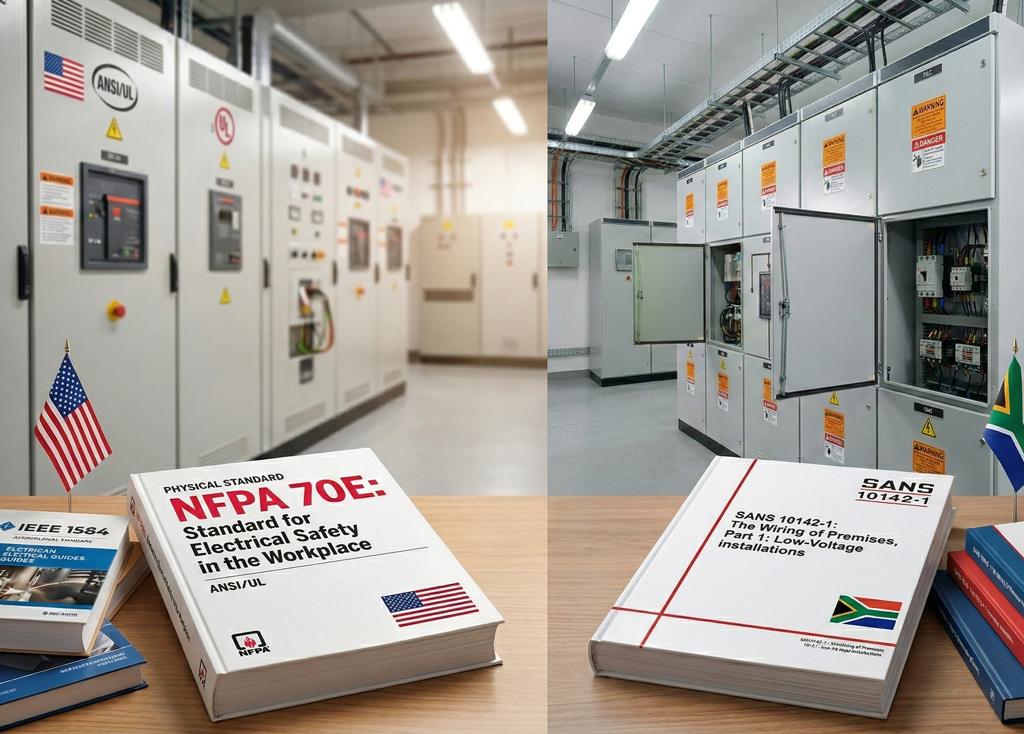
Facilities operating in South Africa may be required to navigate two distinct electrical safety frameworks. Local law is enforced through South African legislation and standards, while multinational organisations, particularly those with US parent companies, often require alignment with American safety standards.
This can create confusion about arc-flash compliance, especially when terms such as NFPA 70E, SANS 10142-1, and IEEE 1584 are used interchangeably.
This article explains how NFPA 70E and SANS 10142-1 differ, where they overlap, and how arc flash studies are typically used to support both frameworks without overstating legal or commercial outcomes.
The dual-framework reality
South African facilities may face requirements from:
- Local regulators enforcing South African law
- Corporate EHS policies based on US standards
- Insurers applying international risk frameworks
These requirements are not identical, but they are not inherently contradictory either. Each exists for a different purpose, and each must be understood in its own context.
Legal hierarchy in South Africa
South African law always takes precedence.
Electrical safety obligations arise primarily from:
- The Occupational Health and Safety Act
- The Electrical Installation Regulations
- Applicable South African National Standards, including SANS 10142-1
Compliance with NFPA 70E does not replace or override these obligations. It may support them, but it is not law in South Africa.
What SANS 10142-1 requires
SANS 10142-1 is the South African standard for the wiring of premises. It is referenced through legislation and is enforceable by inspectors from the Department of Employment and Labour.
In relation to arc flash and electrical safety, SANS 10142-1 requires that:
- Electrical installations are safe for persons and property
- Electrical hazards are identified and addressed
- Warning signs and notices are provided where necessary
- Persons working on electrical installations are protected
- Work is carried out by competent persons
SANS 10142-1 establishes what must be achieved, but it does not prescribe a detailed arc flash calculation methodology or specific incident energy thresholds.
What NFPA 70E requires
NFPA 70E is a US consensus standard titled Standard for Electrical Safety in the Workplace. It is widely used by US-based organisations and insurers as a structured framework for managing electrical hazards.
NFPA 70E includes detailed requirements for:
- Arc flash risk assessment
- Incident energy calculation or PPE categorisation
- Arc flash boundaries
- PPE selection and ratings
- Equipment labelling
- Electrical safety programmes and training
- Energised work procedures
NFPA 70E provides the how. It is prescriptive and technically detailed, but it has no legal standing in South Africa unless adopted contractually or through corporate policy.
How the two frameworks compare
Where they align
Both SANS 10142-1 and NFPA 70E require:
- Identification of electrical hazards
- Assessment of risk
- Protection of workers
- Use of appropriate PPE
- Warning labels and notices
- Competent persons performing electrical work
- Documentation of safety measures
The underlying safety intent is the same.
Where they differ
|
Aspect |
SANS 10142-1 |
NFPA 70E |
|
Legal status |
Enforceable SA standard |
Voluntary in SA |
|
Focus |
Electrical installation safety |
Electrical work safety |
|
Arc flash method |
Not specified |
IEEE 1584 referenced |
|
PPE detail |
General |
Prescriptive |
|
Labelling |
General warnings |
Detailed content |
|
Programme detail |
Limited |
Comprehensive |
The role of IEEE 1584
IEEE 1584 is the technical guide used to calculate arc flash incident energy. It is referenced by NFPA 70E and widely accepted by insurers and engineers internationally.
IEEE 1584:
- Is a calculation methodology, not a regulation
- Is not mandated by South African law
- Is commonly used to support hazard assessment obligations
When used appropriately, IEEE 1584 calculations provide quantified evidence that electrical hazards have been assessed, which supports both SANS-based compliance and NFPA-based corporate requirements.
Can one arc flash study support both frameworks?
Yes, in practice, a single, well-structured arc flash study can support both SANS 10142-1 obligations and NFPA 70E-based corporate expectations.
This is achieved when the study:
- Uses a recognised calculation methodology
- Is performed or reviewed by a registered Professional Engineer
- Is integrated into South African risk assessments and procedures
- Includes documentation that explicitly references both contexts
- Is implemented through labels, PPE, procedures, and training
This is alignment, not automatic compliance.
What inspectors typically assess
Inspectors from the Department of Employment and Labour do not audit against NFPA 70E. They typically assess whether:
- Electrical hazards have been identified
- Risks have been evaluated
- Controls are in place and implemented
- Workers are trained and competent
- Management has taken reasonable steps to prevent harm
An arc-flash study can support these expectations, but only when properly implemented.
What corporate audits typically assess
Corporate EHS audits often focus on:
- Whether arc flash risk assessments exist
- Whether recognised methodologies were used
- Whether labelling and PPE align with calculated hazards
- Whether training is documented
- Whether studies are current
NFPA 70E is often used as the benchmark for these audits, regardless of local legal requirements.
Common misunderstandings
“NFPA 70E is mandatory in South Africa”
It is not. It may be contractually required, but it is not law.
“SANS 10142-1 does not cover arc flash”
It does, indirectly, through general electrical safety obligations.
“One study guarantees compliance with everything”
No study guarantees outcomes. Implementation and management oversight are required.
“More detailed standards always mean higher cost”
Not necessarily. Accuracy often reduces unnecessary conservatism.
A practical alignment approach
Facilities seeking to address both frameworks typically:
- Perform an arc flash study using current engineering methods
- Reference South African legal obligations explicitly in documentation
- Use detailed labels that exceed minimum local requirements
- Select PPE based on calculated risk
- Train workers on site-specific hazards
- Maintain a single update and review cycle
This reduces duplication without overstating benefits.
When a dual-framework approach makes sense
A combined approach is commonly used where:
- A US parent company imposes NFPA-based EHS policies
- International insurers request detailed arc flash analysis
- Facilities operate in higher-risk electrical environments
- Organisations want defensible, best-practice documentation
Purely domestic facilities may still benefit, but it is not mandatory.
Professional responsibility
Arc flash studies influence life-safety decisions. For this reason:
- Professional engineering involvement matters
- Assumptions must be documented
- Limitations must be understood
- Implementation must be verified
The standard referenced matters less than the quality of professional judgment applied.
What this article does and does not claim
It does:
- Clarify the difference between SANS 10142-1 and NFPA 70E
- Explain how arc flash studies fit into both frameworks
- Support informed decision-making
- Reduce confusion around dual requirements
It does not:
- Claim legal equivalence between standards
- Guarantee insurance outcomes
- Replace site-specific engineering or legal advice
- Promote unnecessary duplication of work
Final perspective
South African facilities are not choosing between SANS 10142-1 and NFPA 70E. They are operating within a local legal framework while responding to international governance expectations.
Handled carefully, arc flash studies can support both without exaggeration, fear-based messaging, or over-commitment. The goal is clarity, defensibility, and professional execution, not compliance theatre.
Disclaimer
This article provides general information only and does not constitute legal advice, engineering design, or site-specific compliance guidance. Requirements vary by facility, corporate policy, insurer, and operating context. Facilities should engage suitably qualified professionals for project-specific advice.